Description
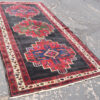
Traditional tribal rug from central Iran. These striking geometric carpets are typically woven by Afshari weavers in the Sirjan region, an area also known for the more formal Kerman carpets.
Excellent overall condition. Very minor wear on the wool pile. Cotton fringes and side cords are in great shape.
This finely woven village rug is quite sturdy without holes or weak spots, and could be used in a high foot traffic area of the home.
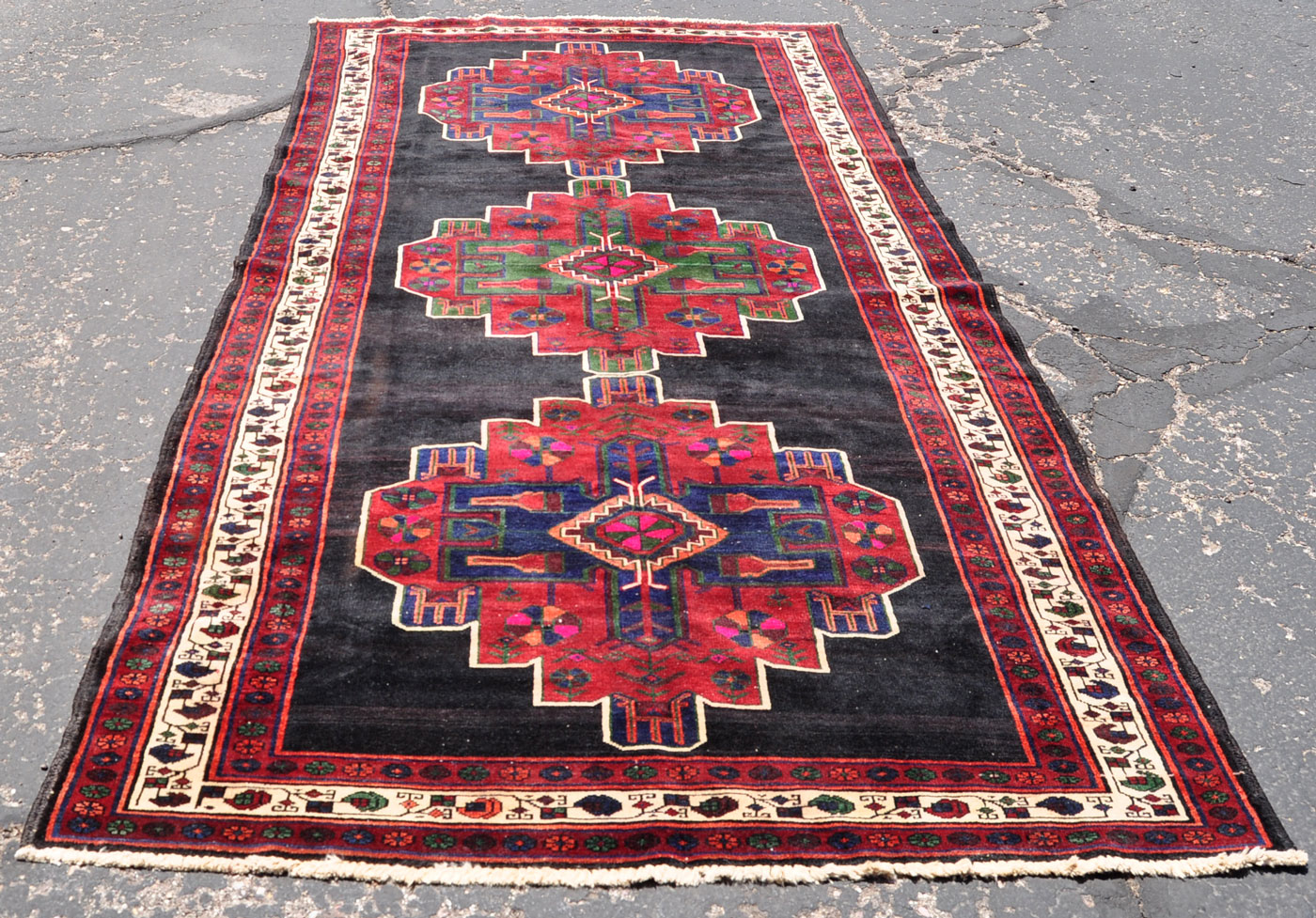
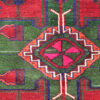
The field color is black while reds blues, greens and white are the primary additional colors.
Fantastic tribal art for your floor! Last photo with Morgan silver dollar shows the back of the rug.
Exact size is 9 ft. 9 in. by 4 ft. 10 in. 1970s.
Sirjan, located in the southwest corner of Kerman province, is a collection point for Afshari rugs. It is the second largest city of the province after Kerman. As the intersection of major roads connecting the four Southern provinces, Sirjan has grown into a major transportation and market center.
Many of the people of the region are of Afshar ancestry. The Afshari were a principle tribe of the Oguz and were an important Kizil Bash tribe during the Safavid dynasty. They revolted in the late 16th century and Shah Abbas split them up to disperse their power.
Sirjan rugs typically have bold patterns and colors. Designs are usually geometric, although sometimes they feature floral rose motifs. Sirjan rugs often feature one or multiple medallions. Three medallions, such as in this carpet, are common.
Colors range from red field to black fields. They are finely woven for tribal rugs and the weaver typically clips the wool pile short to showcase the designs.
The Afshar tribe has a remarkable history, and its weavers create some of the most beautiful village rugs in Iran.
Describing the Afshari, Wikipedia notes:
“The Afshar, also spelled Awshar or Afşar, are one of the Oghuz Turkic peoples. These originally nomadic Oghuz tribes moved from Central Asia and initially settled in Iranian Azerbaijan, later being relocated by the Safavids to Khurasan and Mazandaran. Today, they are variously grouped as a branch of the Turkmens or the Azerbaijanis.
Afshars in Iran remain a largely nomadic group, with tribes in central Anatolia, northern Iran, and Azerbaijan. They were the founders of the Afsharid and Karamanid dynasties. Nader Shah, who became Shah of Iran in 1736, was from the Qirqlu tribe of Afshar.”
Shipping will be $34 within the continental U.S. Or free pickup in Tucson, AZ.
Please email me with questions. Thank you.
(Si0005 N23)